
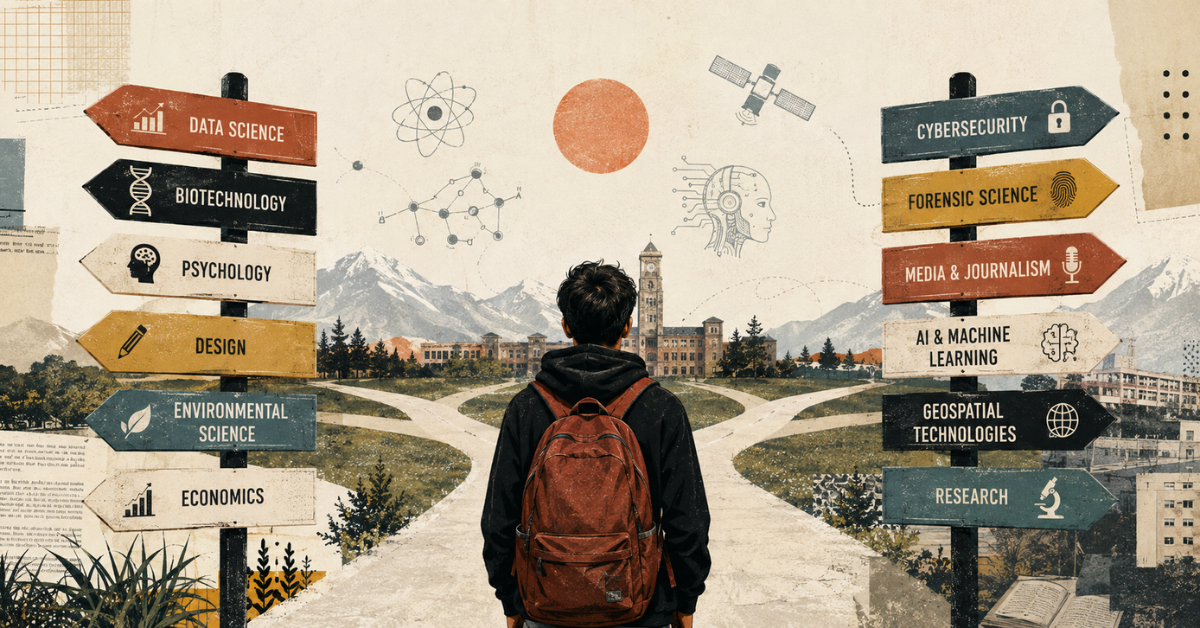
For many students, choosing the Science stream after Class 10 seems to lead to just two destinations: MBBS through NEET or engineering through JEE. These are well-established career paths, but they are not the only ones worth considering.
From artificial intelligence, computer science and data science to biotechnology, biochemistry, research, psychology, economics, design, media and environmental science, there are many fields that students can explore after Class 12.
This guide looks beyond the usual doctor and engineer route and brings together promising and often overlooked career paths, along with the courses, eligibility, admission routes and opportunities they can lead to.
One important point: “beyond NEET and JEE” does not always mean “without NEET or JEE.” Some colleges use NEET or JEE scores for admission to courses other than MBBS and B.Tech. Where that happens, we have mentioned it so students can understand both the career and the route to enter it.
A quick guide to some common terms
B.Sc. (Bachelor of Science)
B.Sc. is an undergraduate degree covering subjects such as Physics, Chemistry, Mathematics, Biology, Computer Science, Statistics and many others. Traditionally, most B.Sc. programmes in India were three years long. Under the newer undergraduate framework introduced following NEP 2020, universities can offer both three-year bachelor’s degrees and four-year bachelor’s degrees, depending on the programme.
B.Sc. (Hons.)
Honours generally indicates a greater focus and depth in a particular subject. Under the newer four-year undergraduate framework, students can pursue a four-year Bachelor’s degree with Honours. Students who choose the Honours with Research pathway undertake a substantial research component along with the required coursework.
B.Sc. and B.S.
B.Sc. and B.S. can both stand for Bachelor of Science. The abbreviation used depends on the university or country. Students should look at the actual curriculum, duration, credits and recognition of the programme rather than the abbreviation alone.
M.Sc. (Master of Science)
M.Sc. is a postgraduate science degree that can be pursued after a relevant bachelor’s degree. A traditional M.Sc. is generally two years long after a three-year bachelor’s degree.
Under the newer framework, students who complete a four-year bachelor’s degree may be eligible for a one-year master’s programme, while students with a three-year bachelor’s degree may follow a two-year master’s route. However, this depends on the university and the specific programme, so students should always check the latest admission rules.
Integrated B.Sc.-M.Sc. / BS-MS
Some universities and institutes offer integrated programmes that combine undergraduate and postgraduate study. These are commonly five-year programmes, after which students receive a master’s degree. The structure varies by institution and may include advanced coursework, projects and research, particularly in the later years.
For example, institutes such as IISERs, NISER, University of Kashmir offer integrated programmes designed for students interested in scientific research, artificial intelligence, management and higher studies.
Common University Entrance Test (CUET-UG): Many Central and State universities (including the Central University of Kashmir, Cluster University of Srinagar, and others) now admit undergraduates via the CUET-UG exam conducted by NTA. Other courses may have university-level tests (e.g. DUET for Delhi University) or national exams (e.g. NID DAT for design, NATA etc.).
PCBM
PCBM stands for Physics, Chemistry, Biology and Mathematics. Students who have all four subjects in Class 11 and 12 have a particularly wide range of options because they can meet the subject requirements for many programmes in both the biological and mathematical sciences.
One important thing to remember
The duration, eligibility and admission process can vary from one university to another. A B.Sc. programme at one university may be three years, while a similar programme at another may follow a four-year structure.
Before applying, students should always check the latest prospectus of the university or institute for the required Class 12 subjects, entrance examination, course duration, degree structure and eligibility for higher studies
| Career / Field | Eligibility (Streams) | Degree / Course | Admission | Duration | Future / Career Options |
|---|---|---|---|---|---|
| Computer Science & IT | PCM / PCMB; (Arts with Math possible) | B.Sc. Computer Science, BCA, B.Tech (CSE) | CUET / JEE / Univ. entrance | 3–4 years | Software developer, IT companies, government tech jobs, startups, higher studies (M.Sc., MCA, M.Tech), data analytics |
| Data Science & Analytics | PCM / PCMB (some accept PCB/Arts if Math) | B.Sc. Data Science / B.Sc. Statistics / B.Tech Data Science | CUET / Univ. entrance / JEE | 3–4 years | Data analyst, data scientist, business analyst, AI & ML roles, research, higher studies (M.Sc. Data Science) |
| Artificial Intelligence & Machine Learning | PCM / PCMB (some accept PCB/Arts if Math) | B.Tech (AI/ML) / B.Sc. AI & ML / B.Sc. Computer Science | JEE / CUET / Univ. entrance | 3–4 years | AI engineer, ML researcher, NLP specialist, robotics, automation, R&D (sector demand is growing rapidly) |
| Cybersecurity | PCM / PCMB (other backgrounds possible) | B.Sc. Cybersecurity / BCA (Cybersecurity) / B.Tech (Cybersecurity) | CUET / Univ. entrance / JEE (for B.Tech) | 3–4 years | Cybersecurity analyst, SOC (Security Operations) specialist, penetration tester, digital forensics, security architect (high demand in government & industry) |
| Actuarial Science | PCM (Math compulsory) / Commerce + Math | B.Sc. Actuarial Science / B.Com/BBA + actuarial exams | Univ. admission | 3–4+ years | Actuary (insurance, finance), risk analyst, data analyst, finance, consulting (newly qualified actuary salaries ~ ₹15-20 lakh) |
| Statistics | PCM / Commerce+Math / PCMB | B.Sc. Statistics / B.Stat. | CUET / Univ. entrance | 3–4 years | Statistician, data scientist, biostatistician, market researcher, finance, government data agencies, research |
| Biotechnology | PCB / PCMB | B.Sc. Biotechnology / B.Tech (Biotechnology) | CUET / Univ. entrance | 3–4 years | Biotech industry (pharma, agritech), research labs, genetic engineering, diagnostics, M.Sc. Biotechnology or related, PhD (India’s bioeconomy is growing fast) |
| Bioinformatics | PCB (with Math/CS advantageous) | B.Sc. Bioinformatics / B.Tech Bioinformatics | CUET / Univ. entrance | 3–4 years | Genomics, computational biology, drug discovery, pharma R&D, bio-data science (combines biology, CS, stats) |
| Nuclear Medicine Technology | PCB / PCMB | B.Sc. Nuclear Medicine Tech (Allied Health) | Univ entrance or merit | 3–4 years | Operate nuclear imaging equipment (PET, SPECT), diagnostic centers, oncology centers, research in medical imaging |
| Radiology & Medical Imaging Technology | PCB / PCMB | B.Sc. Medical Imaging Tech / B.Sc. Radiology Tech | Univ./institute entrance or merit | 3–4 years | Medical imaging tech (X-ray, CT, MRI, ultrasound), hospital radiology departments, diagnostic centers |
| Medical Laboratory Technology | PCB / PCMB | B.Sc. Medical Lab Tech (BMLS) | Univ./institute entrance or merit | 3–4 years | Lab technologist in pathology, microbiology, hematology, clinical labs, biotech labs (critical in healthcare) |
| Forensic Science | PCB (some accept PCM) | B.Sc. Forensic Science | CUET / Univ. entrance / merit | 3–4 years | Crime laboratories (forensic analyst), toxicology, DNA profiling, cyber forensics, police science, criminology research |
| Geoinformatics & Remote Sensing (GIS) | PCM / PCMB | B.Sc. Geoinformatics / B.Sc. Geography (with GIS focus) | CUET / Univ. entrance | 3–4 years | GIS analyst, remote sensing specialist, urban planning, environmental monitoring, disaster management, government GIS departments |
| Geology & Earth Sciences | PCM / PCMB | B.Sc. Geology / Earth Sciences | CUET / Univ. entrance | 3–4 years | Mineral exploration, petroleum mining, groundwater/hydrogeology, environmental geoscience, geological surveys, resource management |
| Renewable Energy & Energy Science | PCM / PCMB | B.Sc. Energy Science / B.Tech (Renewable Energy) | CUET / Univ. entrance / JEE | 3–4 years | Solar/wind energy companies, smart grid, battery tech, energy management, sustainability projects |
| Environmental Science | PCB / PCMB (other science streams) | B.Sc. Environmental Science | CUET / Univ. entrance | 3–4 years | Environmental consultant, pollution control, climate policy, conservation, NGOs, ESG roles in industry |
| Economics & Quantitative Economics | Maths recommended/compulsory | B.A./B.Sc. Economics (often with Maths) | CUET / Univ. admission | 3–4 years | Economist, financial analyst, policy analyst, data analyst, banking, consulting, higher studies (M.A., M.Sc., MBA) |
| UX & Product Design | Any (creative aptitude needed) | B.Des. (UX Design / Interaction Design / Product Design) | NID DAT / UCEED / Univ. entrance | 4 years | UX/UI designer, product design, design research, design strategist in IT/product companies, startups |
| Animation, VFX & Game Design | Any | B.Des. / B.Sc. (Animation, VFX, Game Design) | Institute entrance (e.g. NID/NIFT/digital arts exam) | 3–4 years | Animator, VFX artist, game developer, 3D modeler, multimedia specialist, entertainment industry (films, games), freelancing |
| Psychology | Any | B.A./B.Sc. Psychology | CUET / Univ. entrance | 3–4 years | Clinical Psychology (with further degree), counselling, human resources, educational psychology, research, UX research (behavioral science roles) |
| Mass Media & Journalism | Any | B.A. (Journalism) / BMMMC / B.Sc. (Media Studies) | CUET / Univ. entrance / Media entrance tests | 3 years | Journalist, media planner, PR, digital marketing, content creation, advertising, higher studies (M.A. in Mass Comm, MBA in Media) |
| Integrated Law | Any | BA LLB (Integrated) | CLAT/NLU exam / Univ. law entrance | 5 years | Lawyer, corporate counsel, judiciary exams, legal services, policy, governance (law degree gives many career paths) |
| Fashion & Textile Design | Any (creative aptitude) | B.Des. (Fashion Design) / B.Sc. (Fashion & Textile Tech) | NIFT exam / Univ. entrance | 4 years | Fashion designer, textile industry, apparel R&D, merchandising, retail management, entrepreneurship (India’s apparel industry is large) |
| Architecture & Planning | PCM (Math compulsory) | B.Arch (Bachelor of Architecture) | NATA / JEE Paper-2 | 5 years | Architect, urban planner, interior architect, construction design, landscape architecture, government planning departments |
| Integrated Science (BS-MS) | PCM / PCMB | BS-MS (Integrated 5-year science degree) – e.g. IISER, NISER | IAT / NEST / JEE Advanced | 5 years | Research scientist, PhD, specialized technical roles (IISER/NISER are premier science institutes, akin to IITs for science) |
Choosing the right path
A long list of courses can be useful, but choosing between them is not always easy. The best option is not necessarily the course with the most impressive name or the highest salary mentioned online.
A better starting point is to ask:
What subjects do I enjoy? What kind of work do I want to do? And what skills will I need to build for that career?
A student who enjoys biology but does not want to become a doctor, for example, has options in biotechnology, biochemistry, bioinformatics, forensic science, environmental science and allied healthcare.
Similarly, a student who enjoys mathematics and computers does not have to limit themselves to traditional engineering. Computer science, statistics, data science, artificial intelligence, cybersecurity, economics and actuarial science can lead to very different careers.
If you like Biology but don’t want MBBS
Biology does not have to end with NEET.
Students interested in biology can explore fields such as biotechnology, biochemistry, bioinformatics, microbiology, forensic science, environmental science, genetics and allied healthcare.
Some of these fields are more research-oriented, while others lead to jobs in hospitals, diagnostic laboratories, pharmaceutical companies, agriculture, food technology and biotechnology.
For students who enjoy both biology and computers, bioinformatics is particularly interesting. It combines biology with computing, statistics and data analysis and is used in areas such as genomics, drug discovery and computational biology.
If you like Mathematics and Computers but don’t want the usual engineering route
Computer science is much broader than B.Tech.
Students can enter computing through programmes such as B.Sc. Computer Science, BCA, Statistics, Data Science and other specialised degrees, depending on the institution.
From there, students can build careers in software development, data analysis, artificial intelligence, cybersecurity, cloud computing and other technology fields.
The important thing is to look beyond the degree title. In technology, projects, internships, problem-solving ability and practical skills can matter as much as the name of the course.
Don’t overlook Statistics and Economics
Statistics is one of the most useful foundations for a data-driven economy. It can lead to careers in data analysis, finance, research, government statistics, market research and biostatistics.
Economics can also lead well beyond traditional banking or government jobs. Students who combine economics with mathematics, statistics and programming can move into areas such as financial analysis, consulting, economic research, policy and data analytics.
For students who enjoy mathematics but do not see themselves as engineers, these are worth exploring.
Research is also a career
Research is often overlooked when students think about career options after Class 12.
Institutes such as the Indian Institutes of Science Education and Research (IISERs) and the National Institute of Science Education and Research (NISER) offer dedicated pathways for students interested in science and research.
IISERs offer five-year BS-MS programmes across their campuses, along with specialised four-year BS and B.Tech programmes in areas such as economic sciences, data science and engineering. Admission to IISER programmes in 2026 is through the IISER Aptitude Test (IAT).
NISER offers a five-year Integrated M.Sc. programme for students interested in scientific education and research, with admission through the National Entrance Screening Test (NEST).
These are not alternatives only for students who “couldn’t get into engineering.” They are specialised routes for students who genuinely enjoy science and may want to pursue research, higher studies, R&D or scientific careers.
What about salary?
It is tempting to choose a course based only on salary figures found online. That can be misleading.
A degree does not guarantee a particular salary. Earnings can vary significantly depending on the college, skills, specialisation, experience, location and type of employer.
A student should therefore ask not only:
“How much can I earn?”
but also:
“What can I become good at in this field?”
A field with strong long-term demand can offer good opportunities, but students still need to build the skills that employers actually look for.
Before choosing a course, check these five things
1. Eligibility
Check whether your Class 12 subjects meet the requirements. PCB, PCM and PCMB students can have very different options.
2. Admission route
Do not assume that every course requires CUET, NEET or JEE. Admission can be through CUET-UG, an institute-specific entrance test, merit, or another national examination. Some courses may also use NEET or JEE for admission even though the eventual career is outside MBBS or traditional engineering.
3. The actual curriculum
Two courses with similar names can have very different syllabi. Check what you will actually study for the next three or four years.
4. What comes after the degree
Look at the possible jobs, professional qualifications and postgraduate options before enrolling.
5. The institution
Check recognition, accreditation where applicable, faculty, laboratories, internships, placement record and the institution’s reputation in that particular field.
A course with a modern-sounding name is not automatically a good course. What matters is the quality of the programme and whether it gives you a realistic path towards the career you want.
For students in Jammu and Kashmir
Students should not limit their search to colleges in their immediate area, particularly when considering specialised fields.
Some courses are available only at a limited number of institutions, so it is worth comparing universities across India. At the same time, students should check the admission rules carefully because the same course can have different eligibility and admission requirements at different universities.
For students considering science and research, institutes such as IISERs and NISER are also worth knowing about. For students considering technology, design, law, healthcare, finance or other specialised fields, there are similarly national-level institutions and entrance routes worth exploring.
The important thing is to start with the career you want to explore, then work backwards:
Career → required skills → degree/course → eligible colleges → admission route
rather than choosing a degree first simply because everyone around you is choosing it.
Disclaimer: We have made every effort to ensure that the information in this guide is accurate and up to date. However, eligibility, admission rules, course structures and entrance requirements may change between institutions and academic years. Students should always verify details with the official website or prospectus of the relevant institution before applying.
If you notice an error, outdated information or anything that needs correction, please write to us at [email protected] or [email protected]