
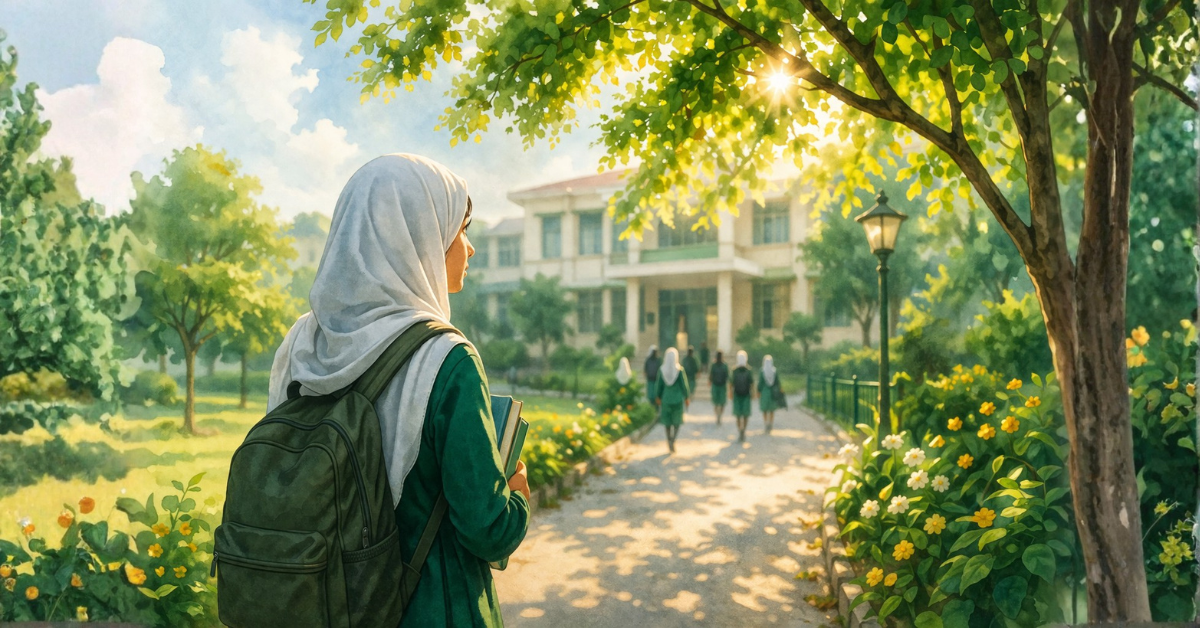
A school is not just a building made of bricks and desks. For a student, it is a second home. It is a sanctuary where parents send their children with blind trust, believing they are in the hands of protectors and guides. But what happens when the protector becomes the predator?
On Monday, April 13, 2026, the Government Girls Higher Secondary School (GHSS) in Sopore became the center of a nightmare. A senior Urdu lecturer was accused of sexually harassing a female student under the guise of setting her dupatta, alongside allegations of sending inappropriate late-night text messages to others.
At this stage, we must not act as judge and jury before the facts are out, as jumping to conclusions risks ruining lives. However, the courage of these students demands immediate respect. We must let the legal process work, but our priority must remain ensuring that every student feels heard, safe, and protected.
What followed the allegations was a massive outpouring of anger. Students from the girls’ school, joined by boys from the nearby Higher Secondary School and Degree College, took to the streets. The situation boiled over into vandalism, vehicles were damaged, schools were shut down by the administration for three days, and police arrested over a dozen youths for the vandalism. The lecturer has since been suspended, an FIR has been lodged, and the government has “attached” him to a school in Gurez pending an inquiry.
But as the dust settles in Sopore, we are left facing an uncomfortable reality. If we focus only on one individual, we ignore the deeper problem. This incident is not isolated—it reflects a larger crisis within the system, where safety gaps are overlooked, boundaries are not clearly defined, and silence is allowed to continue. To truly address this, we must move beyond immediate outrage and understand the everyday reality our students are living in.
We live in a society that beautifully values modesty and respect for elders. When a young girl faces harassment, especially from an older, respected authority figure like a teacher, her first instinct is rarely to shout. Her first reaction is pure panic. Did I do something wrong? Will society blame me? Will my parents pull me out of school? This fear of being misunderstood forces her into silence. When a teacher crosses the line, it breaks her trust in the world and leaves lifelong mental scars. The girls in Sopore who finally showed those text messages were likely suffering in silence for weeks. It takes immense, desperate bravery for a young girl to finally break that silence and say, “Enough.”
But a student’s courage should not be our only line of defense against predators. If fear keeps students silent, then systems must not depend on them to speak at all. When we look at the specific details of how this incident unfolded, glaring procedural failures become obvious. According to a school official speaking to Greater Kashmir, the lecturer went into a classroom to check on a girl who had not joined the morning assembly. Another student, part of the discipline committee, spotted him and questioned his presence. Moments later, it was reported that he inappropriately touched the girl under the pretext of setting her scarf (dupatta).
This exposes a massive blind spot in our physical spaces. Why is a male teacher checking on an absent female student alone in a classroom? We need an immediate, universal rule: only female staff should be allowed to check on female students who miss the morning assembly or are resting in classrooms. Furthermore, schools must adopt a strict “Open-Door Policy.” No teacher should ever be allowed to counsel or speak to a student one-on-one behind a closed solid door; such interactions must happen in open staff rooms or with the door visibly ajar. If a school has after-school activities, a “Two-Adult Rule” must be enforced so no single staff member is ever left alone with a group of minors.
Alongside these rules, as schools now heavily use social media for public relations, they must ensure female staff are included as photographers and communication handlers. Young girls should not be put in uncomfortable situations under the guise of “media duties.” Furthermore, schools must move away from the dangerous practice of storing student media on personal devices; all photographs and videos should be kept on official school storage or secure drives, ensuring that no individual staff member has private ownership of a student’s image. To back this up, basic security measures must become standard, and CCTV cameras must be mandated in all common areas and corridors to ensure transparent, physical safety.
Yet, the threat no longer stops at the school gates; it follows students home in their pockets. Beyond the physical walls, we must address the digital reality of modern education. The internet has completely changed education for the better, but it has also erased traditional boundaries. The Greater Kashmir report highlighted allegations that the teacher was sending texts with “inappropriate words at unsuitable times.”
There must be an absolute boundary when it comes to digital communication. The rule must be clear: zero personal messages. Any communication regarding academics, notes, or school updates should happen exclusively in official, monitored school groups. When student-teacher relationships spill over into personal social media accounts and late-night messages, it creates a dangerous gray area—an ambiguity that breeds misconduct and misunderstanding. Institutions must eliminate that ambiguity through strict accountability.
Setting boundaries is a two-way street, but the adult must always act as the guide. Because students are legally minors, they are emotionally vulnerable and cannot fully understand the weight of crossing personal lines. Therefore, the responsibility to keep interactions strictly academic naturally falls to the teacher. This professional distance is crucial because it keeps students safe, and equally protects dedicated educators from career-damaging situations.
More importantly, we must consider the human cost of this viral outrage. Videos of the brave girls speaking to the media have been widely shared. We must remember that the internet is forever. The long-term psychological and social impact on these minors, whose faces and trauma are now digital commodities, can be devastating. The media and the public must handle such cases with utmost care and responsibility—blurring faces, altering voices, and prioritizing written statements over sensational videos to ensure their courage today does not become a digital burden tomorrow.
Ultimately, this issue cannot be addressed only after a crisis emerges; it requires structural, preventative safeguards. Schools must put in place clear, accessible, and safe complaint mechanisms. We need anonymous grievance boxes, digital reporting forms where disclosing identity is optional, and dedicated mental health and counseling cells adequately staffed by women. Beyond internal rules, schools must invite third-party NGOs or child psychologists to conduct mandatory, yearly boundary and sensitization workshops for both staff and students, breaking the awkwardness of having these vital conversations.
We must create an environment where students know they can speak up without the fear of retaliation or shame. Until the police uncover the complete truth of what happened in Sopore, one priority must remain non-negotiable: the burden of proof belongs to the law, but the burden of protection belongs to all of us.